

YUKIKAWA self-introduction Latter half
Thank you for opening this article.
This sentence you are reading is a translated sentence.
I'm not a celebrity.
You are probably the only one reading this text in the country you live in.
Only you know a Japanese painter named YUKIKAWA.
This sentence is the entrance.

Self-introduction about YUKIKAWA (latter half)
■ Summary for those who do not have time to read
I make geometric and abstract digital art.
Born in a rural farmhouse in Kyoto, after working as an institutional investor in Tokyo, he is now in the world of art.
The side business of my parents' house created my sensibility, and in poverty I started to create works for myself.
Aerospace engineering, the collapse of financial markets, and huge natural disasters have influenced my sensibility and creation.
■ For lucky people who have time to read this article
Like the previous article, the text from here onwards is probably not interesting to anyone other than those who are interested in me.
Addendum 1: If you find this article interesting, you are probably tired. Let's read even a light novel.
Supplement 2: I like movies better than novels.
1. My entrance to art
There are various Japanese traditions, one of which is "kimono".

Kimono is traditional Japanese clothing, and although it comes in various forms, the finest ones are mostly made of silk.
Many modern Japanese wear them only on special occasions such as weddings and funerals.
At the Aoi Matsuri festival, which is one of the three major festivals in Kyoto, you can see people dressed in gorgeous kimonos.
Since the Heian period (about a thousand years ago), various silks have been needed to make kimonos in Kyoto, where aristocratic culture flourished.
Although it wasn't until the 18th century, the silk textile industry became popular around my hometown because it was close to Kyoto.
My family's livelihood was agriculture, but after World War II they were poor, so women woven silk as a side job. The mother's family was also engaged in weaving. Thanks to that, I came into contact with "creation" and "color" from an early age.
In weaving, the pattern and color scheme are planned in advance before starting work.
Of course, there are gradations created from unintended mistakes, but basically, "beauty" is created based on planning and regularity. There may be some disagreements, but at least I learned that way.

Today, fewer people carry on that tradition, and demand for kimono and silk fabrics is declining. In other words, it is declining as an industry. By the beginning of the 21st century, the loom in my family's house had also been removed.
My grandmother said at a place of memories where she once woven colorful silk. "I will make this place a hut for making pickles."
Soon, the traditional silk fabric space became a danger zone dominated by mysterious scents.
2. Encounter with me and digital art
When I was in elementary school (6 to 12 years old), there was a local event to collect used paper (used books, newspapers, etc.) once a year, and I participated like other children. The total amount of used paper that was finally collected was as much as two shipping containers handled by trade vessels.
Unfortunately, however, children rarely learn the importance of resources at this event.
The children were absorbed in packing the old cartoons handed over by the residents into their bags. Some children were accused of collecting adult magazines, but at the same time they were also heroes for adolescent boys.
On the other hand, I participated with the purpose of "getting a book that is rare for me."
The crops continued to be poor every year, but when I participated at the age of 10, I saw postcard-sized books spilling from the garbage piles collected in the schoolyard.

When I picked it up and looked at it, there was a delicate and vibrant picture that I had never seen before.
It was like a postcard book with the work of an artist printed on it. The great natural scenery of a foreign country that I, the son of a poor farmer, would never see in my life was dynamically and colorfully depicted. In contrast to silk fabrics, which are color-coded regularly and clearly, their overly smooth colors and color connections were eerie.
However, I also thought, "There are very beautiful things in the world that I do not know yet."
At the same time, I felt, "I don't like these paintings, but they are amazing."
I took it home as a loot for waste paper recovery labor and looked at it every day.
I couldn't read it at the time, but the pictures on every page contained the same letters in the alphabet, and my mother told me, "It's the signature of a famous digital art painter."
The painter's works was very expensive. After a while, my parents gave me a jigsaw puzzle with the painter's work printed on it.
3. Collecting and learning
From the time I was in junior high school (12 to 15 years old), I started collecting things that I found beautiful. Glasswork and small vases that are sold like junk, etc. In common, all of them had a simple design with randomness and uncertainty.

To raise money for the collection, I did a small business, such as mediating the purchase of card games, which was popular among my friends.
The painting I was most interested in was too expensive to buy, but at that time I found the line drawing and composition of the calendar to be beautiful, so I decorated it instead of decorating the painting. Even now, the wall of my room in my family's house in Kyoto has a calendar that is more than 10 years old.
When I was 17, an exhibition of works by a painter I was interested in was held in the city where my high school was located. Admission was free, so I went to the venue with a friend who wasn't interested in painting.

I enthusiastically went around the venue thinking, "If I find a cheap and good work, I'll buy it." But even the price of the replica was more than 100 times my budget. In the end, there were no works that completely satisfied me, but the price of each work was more than double the average monthly income of Japanese businessmen.
Said a friend. "Everything is expensive. You can't buy it for the rest of your life unless you get rich."
His words were accurate and sad.
I was accustomed to poverty, but I felt a strong sense of urgency as I realized that I wouldn't get much of what I wanted now and in the future.
This experience has moved my life forward.
I turned my life to the financial industry, and while studying for college entrance exams, I started self-taught on financial markets and the economy.
At the same time, I became skeptical about buying works made by others and began to think this way.
"Why do I need to pay a fortune for works that doesn't completely satisfy me?"
I got the idea, "I should make something that I feel beautiful and that I am satisfied with, with my own hands."
4. Started creative activities in Tokyo
After moving to Tokyo to attend university, I started to create works for myself, such as drawing figures on a personal computer, printing them, putting them in a cheap frame and decorating them in the room.
At university, I majored in aerospace engineering, and my specialty was computational fluid dynamics.
The reason I majored in that academic field was that I loved airplanes, but because aerospace engineering was connected to financial engineering, it was also a choice as a stepping stone to the financial industry.
As an aside, NASA engineers flowed to Wall Street in the 1980s, when rocket development shrank in the United States, and they developed financial engineering.

Perhaps due to the influence of aerospace engineering, the theme of my works at that time was "regularity" and "inorganic matter and efficiency".
After graduating, I worked for a bank, working for several years in corporate loan screening and corporate rating, after which I worked in the financial markets sector for economic analysis and asset management. In experience of the financial crisis and natural disasters, the theme of my works has changed to "irregularity and uncertainty" and "emotion and numerical value".

By the way, the above-mentioned "theme" is just my own idea, and I cannot say that the theme will be conveyed to you when you look at the works. I have no education in art, and I don't know the technique to convey. I can only make what I have come up with.
The meaning of my works to you is up to you.
At one point, a bunker drinking with me in my room saw my work hanging on the wall and said.
"I want to decorate the same picture. Whose picture?"
The abrupt word gave me the feeling or excitement of hitting my heart. In the first place, my painting was not made for others. However, in one word of my friend, "impression to convey my sensibility" sprouted in me. No, maybe I noticed the "craving for expression" that had existed from the beginning ... Anyway, I started to want to convey my paintings to others.
Thanks to his remarks, "my painting" became "someone's artwork" in him and "my artwork" in me.
After that, my works spread through him to a small number of businessmen in Tokyo.
A few years later, I found a new source of income that made use of my experience, so I decided to retire from a financial institution and concentrate on creating works.
He was furious when I told him I was leaving the world of financial markets, "Why do you throw away the future?", But now he is a close friend.
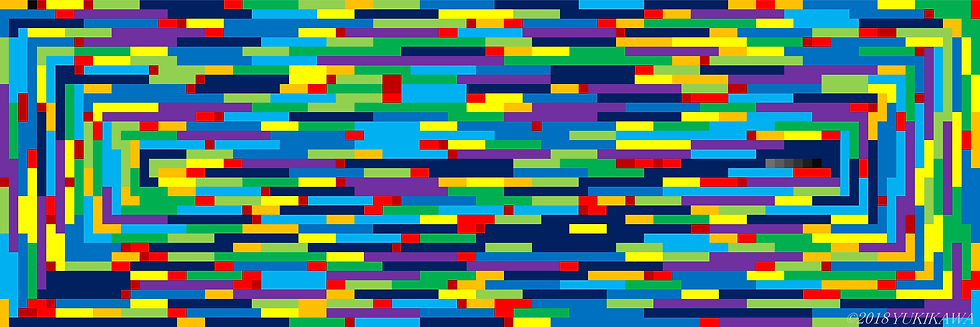
As of 2021, I am creating with the themes of "irregularity in regularity," "regularity in irregularity," and "non-unification."
That's all for this article.
I will write the next one when I feel like it.